


There is a secret system in our body that silently works 24/7 to keep our body in balance. Sadly, most of us were never even taught about it.
This system is the missing link in understanding health. It is the most vital system that the scientists have discovered recently. Scientists since have referred to it as the “hidden system of balance”.
In the early 1990s scientists discovered the Endocannabinoid System (ECS). This remarkable discovery is slowly changing the landscape of human health. Cannabinoids such as CBD and THC were discovered by Israeli scientists in the 1960s, but their mechanism was unknown. Upon its discovery, scientists and doctors referred to the Endocannabinoid System (ECS) as the “master regulator” of the human body.
What Exactly Is the Endocannabinoid System
The Endocannabinoid System (ECS) is a complex cell-signaling network found in all vertebrates. Its main job is to help the body maintain homeostasis. The endocannabinoid system (ECS) plays a crucial modulatory role in regulating anxiety, appetite, emotional processing, mood and depressive states, neural activity, neurogenesis, neuroprotection, reward pathways, cognition, learning and memory, pain perception, and much more. It silently adjusts thousands of signals every second to delicately maintain the balance between the internal and external environment of the human body.
The Architecture of the ECS
The endocannabinoid system (ECS) is essential for the nervous system and regulates neuronal activity and network function.
The ECS is composed of three primary components. Endogenous cannabinoids (endocannabinoids), cannabinoid receptors, and proteins involved in endocannabinoid transport, synthesis, and degradation make up the ECS:
Endocannabinoids
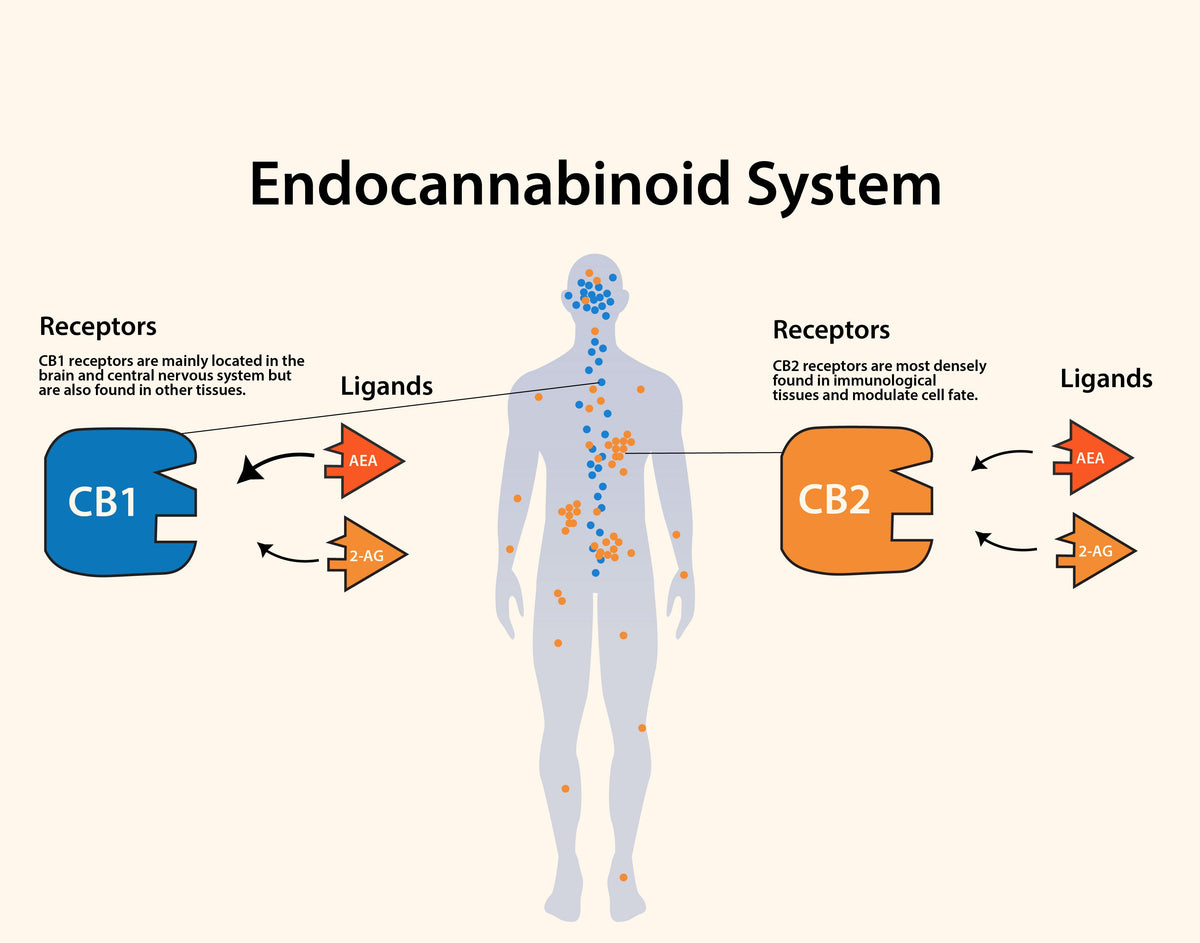
Endocannabinoids are the body's own cannabis-like substances that work as chemical messengers to keep internal balance (homeostasis) and regulate processes such as mood, pain, and appetite. They are "on-demand" signals, which means they are produced in the brain and body from lipid precursors in the nervous system when a signal is required, making it difficult to quantify normal levels. Instead of steady creation, the body generates them when needed to communicate between nerve cells and regulate the action of other neurotransmitters.
The two key endocannabinoids are:
- Anandamide (AEA) often called the “bliss molecule,” linked to mood, motivation, and relaxation.
- 2-Arachidonoylglycerol (2-AG) plays a central role in immunity modulation and inflammation control.

Cannabinoid Receptors
Cannabinoid receptors are found on the cell surface, and when endocannabinoids (the body's own cannabis-like molecules) binds with them, they cause a response in the endocannabinoid system. This system regulates a variety of biological systems to keep homeostasis, including appetite, mood, hormonal regulation and immunological response, etc.
- CB1 receptors – found mainly in the brain and spinal cord; they influence mood, memory, appetite, and pain perception.
- CB2 receptors – located primarily in immune cells and peripheral tissues; they help regulate inflammation and immune responses.
Metabolic Enzymes
These enzymes are involved in the synthesis and degradation of endocannabinoids. These enzymes are also responsible for clearing endocannabinoids once their job is complete, preventing overstimulation.
- FAAH (Fatty Acid Amide Hydrolase) – breaks down anandamide.
- MAGL (Monoacylglycerol Lipase) – degrades 2-AG.
Together, these components form a finely tuned feedback loop: receptors + messengers + regulators - maintaining balance across the body’s systems every second of the day.
How does the ECS Maintains Balance
Imagine two nerve cells (neurons) communicating. If the receiving neuron gets overstimulated (the signal is "too loud"), it can release endocannabinoids that travel backward across the synapse—a process known as retrograde signaling. These endocannabinoids bind to CB1 receptors on the sending neuron and tell it to “calm down.” This feedback loop enables the ECS to fine-tune neural communication in real time.
To help the body maintain homeostasis the delicate internal balance necessary for optimal function especially during stress, injury, or illness, to mention a few. Unlike other signaling systems, the ECS often works backward in a process called retrograde signaling. For example, if inflammation rises over typical levels, the ECS regulates it without affecting other systems. Once the ECS has restored the body's balance, the enzymes degrade the cannabinoids to avoid overcorrection.
Through this mechanism, the ECS maintains balance across:
- Stress & Anxiety: Prevents excessive activation of the “fight-or-flight” response.
- Pain & Inflammation: Modulates inflammatory pathways and pain signals.
- Mood: Enhances emotional stability via reward and pleasure circuits.
- Sleep: Supports a healthy sleep–wake rhythm.
Appetite & Metabolism: Coordinates energy intake and storage.
Every moment our body restores calm after stress or returns to normal after excitement, that’s our ECS at work.
When the ECS Falls Out of Tune
Because the ECS regulates so many systems, even small imbalances can have wide-reaching effects. The Clinical Endocannabinoid Deficiency (CED) hypothesis, proposed by Dr. Ethan Russo, suggests that inadequate endocannabinoid signalling could contribute to chronic conditions such as migraine, fibromyalgia, and irritable bowel syndrome (IBS) to mention a few, disorders often resistant to conventional treatment.
When there is endocannabinoid deficiency causing the ECS to underperform, external cannabinoids from plants known as phytocannabinoids can help restore balance.
- Δ9-THC (Δ9-tetrahydrocannabinol) mimics endocannabinoids by directly binding to CB1 receptors, influencing perception and mood.
- CBD (cannabidiol), on the other hand, doesn’t bind strongly either to the CB1 or CB2 receptor but binds to the allosteric site, thereby helping to preserve our natural anandamide by inhibiting FAAH, allowing it to remain active longer.
Together, these compounds illustrate how plant and human biology are intricately connected.
Expanding Horizons: The Endocannabinoidome
Recent research reveals that the ECS is part of a much larger network ‘the endocannabinoidome’.
This expanded system includes dozens of related receptors, lipid mediators, and enzymes that interact with the ECS to regulate processes like pain, metabolism, neuroprotection, and immunity.
Key areas of ongoing study include:
- The Gut–Brain Axis: The ECS mediates communication between the gut microbiome and the brain, influencing mood, stress, and metabolic health.
- Neuroinflammation: ECS modulation of CB2 receptors can reduce inflammation in the brain, offering potential therapeutic benefits in neurodegenerative diseases like Alzheimer’s and Parkinson’s.
- Mitochondrial Function: ECS signaling affects how cells produce and use energy, linking it to metabolic disorders, obesity and weight management.
This “expanded ECS” is helping scientists uncover how maintaining balance at the molecular level can prevent disease and promote longevity.
Ancient Wisdom Meets Modern Science
Long before scientists named it, traditional Indian medicine may have already understood the principle behind the ECS. Ayurvedic texts describe Vijaya (Cannabis sativa) as a balancing herb harmonizing the body, mind, and spirit. Today, modern science validates this ancient insight: cannabinoids interact directly with our body’s balance system, confirming that holistic wellness is rooted in supporting the ECS.
The Future Is Balance
The discovery of the Endocannabinoid System marks a paradigm shift in understanding of human health and medicine. It reframes health not as the absence of disease, but as the presence of balance. As research deepens, the ECS stands at the frontier of integrative science, bridging molecular biology with ancient healing wisdom. By nurturing this hidden system, we empower the body’s most powerful ability to heal and restore itself.
References:
- Devane, W. A., Hanuš, L., Breuer, A., Pertwee, R. G., Stevenson, L. A., Griffin, G., ... & Mechoulam, R. (1992). Isolation and structure of a brain constituent that binds to the cannabinoid receptor. Science, 258(5090), 1946–1949.
- Matsuda, L. A., Lolait, S. J., Brownstein, M. J., Young, A. C., & Bonner, T. I. (1990). Structure of a cannabinoid receptor and functional expression of the cloned cDNA. Nature, 346(6284), 561–564.
- Mechoulam, R., Ben-Shabat, S., Hanuš, L., Ligumsky, M., Kaminski, N. E., Schatz, A. R., ... & Martin, B. R. (1995). Identification of an endogenous 2-monoglyceride, present in canine gut, that binds to cannabinoid receptors. Biochemical Pharmacology, 50(1), 83–90.
- Di Marzo, V., Melck, D., Bisogno, T., & De Petrocellis, L. (1998). Endocannabinoids: endogenous cannabinoid receptor ligands with neuromodulatory action. Trends in Neurosciences, 21(12), 521–528.
- Russo, E. B. (2016). Clinical endocannabinoid deficiency reconsidered: current research supports the theory in migraine, fibromyalgia, irritable bowel, and other treatment-resistant syndromes. Cannabis and Cannabinoid Research, 1(1), 154–165.
- Munro, S., Thomas, K. L., & Abu-Shaar, M. (1993). Molecular characterization of a peripheral receptor for cannabinoids. Nature, 365(6441), 61–65.
- Wilson, R. I., & Nicoll, R. A. (2002). Endocannabinoid signaling in the brain. Science, 296(5568), 678–682.
Written by:
Dr. Neeraj Kumar Patel (Chief Scientific Officer) & Mr. Tejas Wani (Manager, Marketing & Communications)